 Vitamin B12 is a water-soluble vitamin your body needs for DNA synthesis, red blood cell formation, and healthy nervous system function. When vitamin B12 levels are low, people can develop anemia and experience fatigue and weakness. Therefore, maintaining adequate B12 levels is important for day-to-day energy and overall health. However, B12 can be low even in people who eat Vitamin B12-rich meat and dairy products. Vitamin B12 cannot be produced in the body, so it must be obtained from food or supplements.1
Newer research suggests vitamin B12 (cobalamin) status may influence more than nerve function alone. Findings highlighted in 2026 point to a relationship between vitamin B12 and skeletal muscle mitochondrial function (the cell’s energy-producing machinery), which may contribute to metabolic resilience and aspects of healthy aging.2 In practical terms, maintaining adequate B12 may help support muscle function and strength over time, which can matter for mobility and injury risk as we age.
Evidence
Vitamin B12 has been studied to understand its effects on many aspects of the body’s functioning.
Cardiovascular disease
Vitamin B12, along with folic acid and sometimes pyridoxine (vitamin B6), can lower blood homocysteine levels. Elevated homocysteine is associated with cardiovascular risk, although lowering homocysteine does not always translate into fewer cardiovascular events.
Energy levels
All B vitamins play a role in energy metabolism, but they do not directly “give” energy. People with low vitamin B12 levels may experience fatigue or low energy as an early symptom, often related to anemia.3
Anemia
Low vitamin B12 can reduce red blood cell formation and lead to abnormally large red blood cells (megaloblastic anemia), which can impair oxygen delivery throughout the body.
May depress mood
Some studies suggest an association between low vitamin B12 status and depressive symptoms. B vitamins have been studied for mood support, particularly in people with low or borderline levels.4
Sports performance
Vitamin B12 supplementation does not appear to improve athletic performance unless a person is deficient.
May damage hair, skin, nails and the mouth
Vitamin B12 status has been linked to certain dermatologic changes, and deficiency may be associated with changes in the skin, hair, nails, and oral tissues.5
Vision Health
Vitamin B12 deficiency has been linked to several eye and vision problems. The most serious is optic neuropathy, which can cause progressive, often bilateral vision loss. Low B12 status has also been associated with dry eye symptoms, ocular neuropathic pain, and possible retinal changes. In deficiency-related cases, early identification and appropriate supplementation may improve outcomes.6
Because the body can store vitamin B12, deficiency may develop slowly, and symptoms may take years to show up. Vitamin B12 is also important for normal nerve function, including the myelin sheath (the protective fatty layer around nerves). For that reason, B12 is sometimes discussed as a supportive nutrient in conditions where nerve health is a concern, although the strength of evidence varies by condition and by whether a person is actually deficient.
Vitamin B12, folate, and vitamin B6 are involved in homocysteine metabolism. When B12 is low, homocysteine can rise, and elevated homocysteine has been associated with several eye conditions (including glaucoma, diabetic retinopathy, and optic neuropathy).7
Cataracts
In a large population study, researchers reported an association between cataract incidence and higher homocysteine levels, and vitamin B12 appeared to modify that relationship.
Macular degeneration (AMD)
Some research suggests higher dietary intake of certain B vitamins may be associated with lower rates of advanced age-related macular degeneration. Evidence is mixed: a meta-analysis reported that AMD is associated with higher homocysteine levels and lower vitamin B12 levels, but whether supplementation changes outcomes remains under evaluation.8
Optic nerve conditions and ocular neuropathic pain
Optic neuropathy can occur in vitamin B12 deficiency, and case reports describe vision improvement after B12 treatment in some patients. Imaging studies have also reported thinner retinal nerve fiber layers in people with vitamin B12 deficiency. For ocular neuropathic pain, a case report described improvement with vitamin B12 supplementation.9
Nutritional optic neuropathy (broader nutrient deficiency pattern)
Nutritional optic neuropathy can result from inadequate intake or absorption of essential nutrients needed for optic nerve function. It is most often discussed in relation to B-complex deficiencies, including thiamine (B1) and cyanocobalamin (B12), and may also involve riboflavin (B2), niacin (B3), pyridoxine (B6), and folate. Mechanistically, deficiencies may contribute to mitochondrial dysfunction and reduced cellular energy (ATP), which can damage nerve tissue over time.10
It is possible that many vitamin B12-deficient patients go undiagnosed, putting them at risk of irreversible neurological complications.11
Brain and Memory
Vitamin B12 deficiency has been associated with memory problems, particularly in older adults.12 Another study found that even vitamin B12 levels on the low side of normal can contribute to poorer memory performance.13
Low B12 status has also been linked with cognitive impairment and neurodegenerative disease risk in observational research. Reviews note that while a small subset of dementia cases may be reversible when B12 deficiency is the cause, B12 therapy does not appear to improve cognition in people who are not deficient.14
Symptoms and Testing for Vitamin B12 Deficiency
Vitamin B12 deficiency can come on gradually, so it is easy to miss at first. Common symptoms include extreme fatigue, muscle weakness, numbness or tingling in the hands and feet, memory problems, and a sore or red tongue. Some people also notice dizziness, mood changes, pale or slightly yellow skin, and digestive issues. Because these symptoms can overlap with many other conditions, a blood test is needed to confirm whether low B12 is the cause.
Key signs of vitamin B12 deficiency
- Neurological symptoms: Tingling or “pins and needles,” numbness in the hands or feet, balance problems, depression, confusion, and memory changes.15
- Physical fatigue: Persistent exhaustion and muscle weakness, even after resting.
- Skin and mouth changes: Pale or slightly yellow skin, and a sore, inflamed, or smooth tongue (glossitis).
- Cardiovascular and digestive symptoms: Shortness of breath, dizziness, heart palpitations, nausea, diarrhea, and loss of appetite.
When to seek care
If symptoms persist, especially neurological symptoms such as tingling, numbness, or balance issues, it is worth talking with a clinician. Untreated vitamin B12 deficiency can lead to lasting nervous system problems, so earlier evaluation is safer.
How vitamin B12 deficiency is diagnosed
Do not attempt to self-diagnose Vitamin B12 deficiency yourself. Go to the doctor if you suspect a deficiency. A clinician may use a combination of tests, including:
- Serum B12 level: Measures the amount of vitamin B12 in the blood.
- Complete blood count (CBC): Looks for signs of anemia, including large red blood cells.
- Methylmalonic acid (MMA) and homocysteine: Additional markers that can help confirm deficiency, especially when B12 levels are borderline.
Why vitamin B12 deficiency happens
Vitamin B12 deficiency generally occurs in one of two ways: either your diet does not provide enough B12, or your body does not absorb B12 effectively from the foods you eat.
Who is at higher risk?
People at higher risk of vitamin B12 deficiency include:
- Older adults
- People with gastrointestinal disorders such as Crohn’s disease or celiac disease
- People taking proton pump inhibitors long-term for chronic heartburn
- People who have had gastrointestinal surgeries such as bariatric surgery or bowel resection
- People taking metformin for blood sugar control
- Vegans and some vegetarians (B12 is naturally found mainly in animal foods).
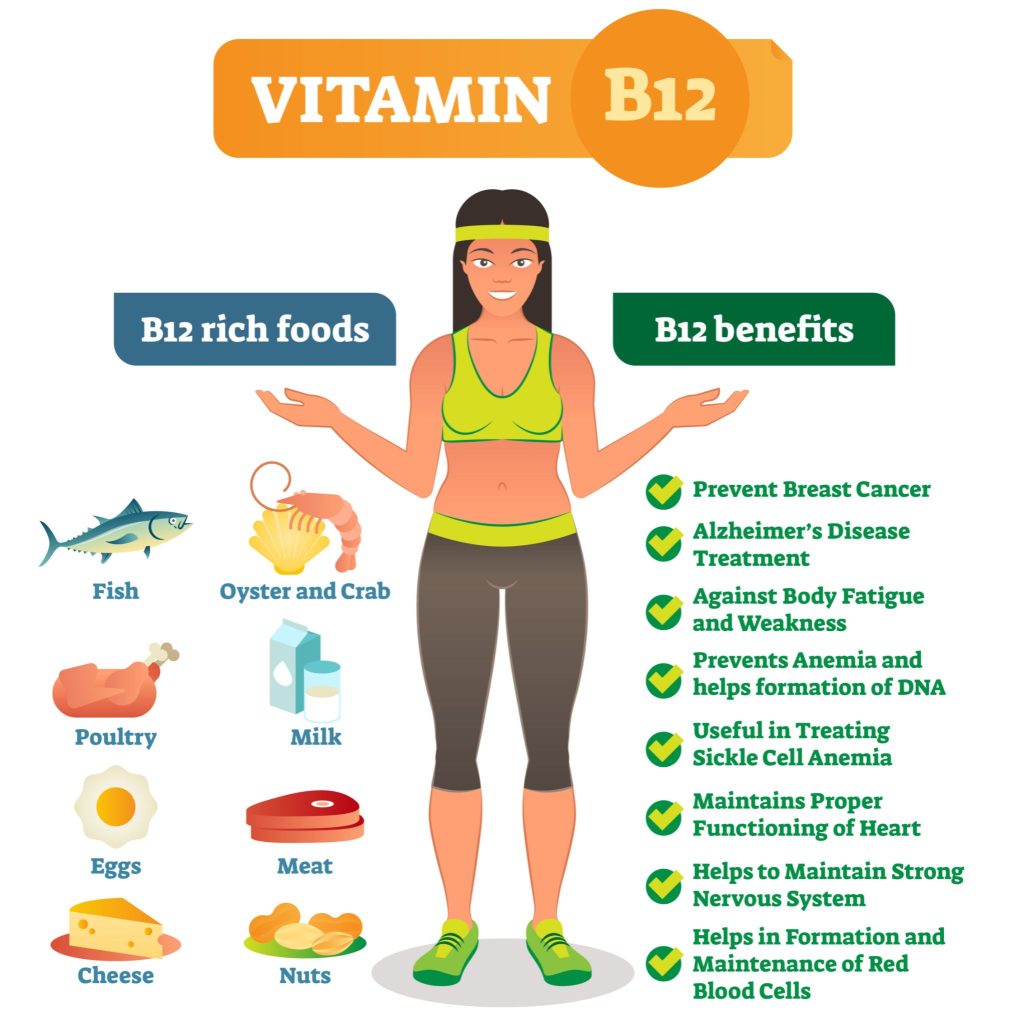
Foods high in vitamin B12
Vitamin B12-rich foods are primarily animal-based, including shellfish (clams), organ meats (liver), fish (salmon, trout, tuna), beef, dairy products, and eggs. For vegans or vegetarians, fortified foods such as nutritional yeast and fortified cereals can help increase intake. Note: Vitamin B12 injections are vegan-friendly because B12 is produced by microorganisms rather than animals.
Recommended dosage
For most adults, the recommended dietary allowance (RDA) is 2.4 micrograms (mcg) per day, with higher needs during pregnancy and lactation.
Interactions
Certain medications may reduce vitamin B12 absorption, including aminosalicylic acid, colchicine, metformin, and acid-reducing medicines such as proton pump inhibitors (omeprazole, lansoprazole, etc.).
Vitamin C may reduce vitamin B12 availability when taken at the same time, so it is often recommended to separate vitamin C and B12 supplements by a couple of hours.
Suggested supplements to consider
Dr. Grossman’s Complete Eye Formula 2oz (oral spray)
Dr. Grossman’s Meso Plus Formula with Astaxanthin – 90 vcaps (3-month supply)
Advanced Eye & Vision Support Formula (whole food) 60 vcaps
MethylCare™ 120 vcaps – includes B12 1,000 mcg, folate 1330 mcg, other B vitamins, and much more. Supports heart function and energy production.
ReVision Formula (wild-crafted herbal formula) 2 oz – based on classic Chinese medicine Liver tonic formula to help support healthy circulation and blood flow throughout the eyes and body.
Dr. Grossman’s Blood Vessel Control Formula 2oz – helps reduce the risk of unwanted blood vessel growth, supports healthy circulation, reduces inflammation, and more.
Dr. Grossman’s Bilberry/Ginkgo Combination 2oz (60ml) – helps support healthy circulation, and strengthens blood vessels and capillaries.
Dr. Grossman’s Whole Food Organic Superfood Multi-Vitamin 120 Vcaps – whole food, organic, GMO-free multivitamin.
H2 Elite Molecular Hydrogen 60 tabs
NMN Wonderfeel Capsul 60 vegcaps – helps protect ganglion cells in the retina and optic nerves from damage, reduces inflammation, supports the immune system.
Supplement Packages
AMD Package 1 (3-month supply)
Brain and Memory Support Package 1
Recommended Books
Natural Eye Care: Your Guide to Healthy Vision and Healing
Natural Parkinson’s Support: Your Guide to Preventing and Managing Parkinson’s
- National Institutes of Health, Office of Dietary Supplements. “Vitamin B12 – Fact Sheet for Health Professionals.” https://ods.od.nih.gov/factsheets/VitaminB12-HealthProfessional/ ↩
- SciTechDaily. “New Research Shows Vitamin B12 May Hold the Key to Healthy Aging.” https://scitechdaily.com/new-research-shows-vitamin-b12-may-hold-the-key-to-healthy-aging/ ↩
- O’Leary F, Samman S. Vitamin B12 in health and disease. Nutrients. 2010 Mar;2(3):299-316. doi:10.3390/nu2030299. https://www.ncbi.nlm.nih.gov/books/NBK441923/ ↩
- Young LM, Pipingas A, White DJ, Gauci S, Scholey A. A systematic review and meta-analysis of B vitamin supplementation on depressive symptoms, anxiety, and stress. Nutrients. 2019 Sep 2;11(9):2232. doi:10.3390/nu11092232. https://pmc.ncbi.nlm.nih.gov/articles/PMC6770181/ ↩
- Brescoll J, Daveluy S. A review of vitamin B12 in dermatology. Am J Clin Dermatol. 2015 Feb;16(1):27-33. doi: 10.1007/s40257-014-0107-3. PMID: 25559140. ↩
- Othman I, Tai E, Kuganasan S, Abu N. Vision Loss as a Presenting Symptom of Vitamin B12 Deficiency. Cureus. 2024 May 11;16(5):e60113. doi: 10.7759/cureus.60113. PMID: 38864050; PMCID: PMC11164691. ↩
- Huang P, Wang F, Sah BK, Jiang J, Ni Z, et al. Homocysteine and the risk of age-related macular degeneration: a systematic review and meta-analysis. Sci Rep. 2015;5:10585. ↩
- Merle BMJ, Barthes S, Féart C, Cougnard-Grégoire A, Korobelnik JF, Rougier MB, Delyfer MN, Delcourt C. B Vitamins and Incidence of Advanced Age-Related Macular Degeneration: The Alienor Study. Nutrients. 2022 Jul 8;14(14):2821. doi: 10.3390/nu14142821. PMID: 35889778; PMCID: PMC9318446. ↩
- Shetty R, Despande K, Ghosh A, Sethu S. Management of ocular neuropathic pain with vitamin B12 supplements: a case report. Cornea. 2015;34(10):1324-1325. ↩
- Ata F, Bint I, Bilal A, Javed S, et al. Optic neuropathy as a presenting feature of vitamin B-12 deficiency: a systematic review of literature and a case report. Ann Med Surg (Lond). 2020;60:316-322. doi:10.1016/j.amsu.2020.11.010. ↩
- McCaddon A. Vitamin B12 in neurology and ageing; clinical and genetic aspects. Biochimie. 2013;95:1066-1076. doi:10.1016/j.biochi.2012.11.017. ↩
- Nalder L, Zheng B, Chiandet G, Middleton LT, de Jager CA. Vitamin B12 and Folate Status in Cognitively Healthy Older Adults and Associations with Cognitive Performance. J Nutr Health Aging. 2021;25(3):287-294. doi: 10.1007/s12603-020-1489-y. PMID: 33575718; PMCID: PMC12280608. ↩
- Köbe T, Witte AV, Schnelle A, Grittner U, Tesky VA, Pantel J, Schuchardt JP, Hahn A, Bohlken J, Rujescu D, Flöel A. Vitamin B-12 concentration, memory performance, and hippocampal structure in patients with mild cognitive impairment. Am J Clin Nutr. 2016 Apr;103(4):1045-54. doi: 10.3945/ajcn.115.116970. Epub 2016 Feb 24. PMID: 26912492. ↩
- Moore E, Mander A, Ames D, Carne R, Sanders K, et al. Cognitive impairment and vitamin B12: a review. Int Psychogeriatr. 2012;24(4):541-556. ↩
- National Institutes of Health, Office of Dietary Supplements. “Vitamin B12 – Fact Sheet for Health Professionals.” https://ods.od.nih.gov/factsheets/VitaminB12-HealthProfessional/ ↩