
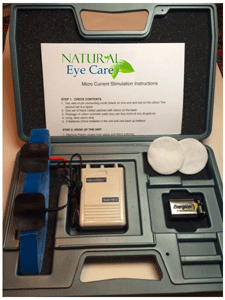
Microcurrent stimulation treatment protocols are designed to help people with retinal disease. MCS works by supporting nourishment and healing to the back of the eyes as well as possibly some cell regeneration. Retinal tissue is easily the most complex tissue in the entire body, and we tell people that they need to commit to regular treatment for a year, because it may take up to a year before they first see results, though benefits may be seen much sooner.
For individuals researching microcurrent for eyes, microcurrent eye therapy, or a microcurrent eye treatment approach for retinal health, microcurrent stimulation therapy has been studied for its potential to support retinal and optic nerve function.
A number of research studies have suggested that daily use of specific microcurrent stimulation for eyes helps promote retinal (as well as optic nerve) health in 3 different ways:
 Did you know that how well your gut works is directly related to your healthy vision and your healthy brain?
Healthy gut microbiota function is linked to normal central nervous system (CNS) function. The microbiota is defined as all microorganisms in a particular location, such as the GI tract, and their respective genetic material. The microbiome is initially developed transmission through the placenta, amniotic fluid, and meconium. The human gut microbiota comprises more than 100 trillion microorganisms associated with multiple functions, from nutrient metabolism to protection against pathogens.
Read More »
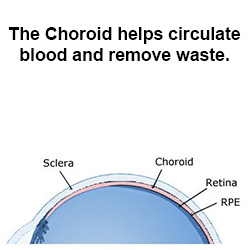 The eye has a delicate vascular system. Eye circulation brings oxygen and nutrients to the eyes. It also removes waste products. The “choroid” is the part of the eye that circulates blood. Fats and blood clots that damage the arteries can also clog the arteries and veins in the eyes. This condition is common as people age. Poor circulation is associated with many eye diseases:
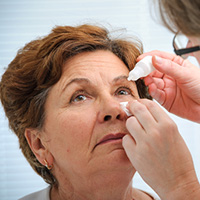 Eye drops may soon replace gene therapy injections for Age-Related Macular Degeneration and Diabetic Retinopathy. 1 Delivering drugs to the back of the eye currently requires an invasive injection. The associated discomfort discourages many patients from consenting to this type of treatment. The new delivery technique is special eye drops that gently make their way to the back of the eye.
Excessive blood vessel growth is damaging to the
Read More »
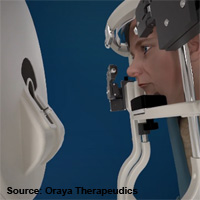 A one-time treatment for patients with wet age-related macular degeneration (AMD) is gaining popularity in Europe. Oraya Therapy, made by US-based company Oraya Therapeutics, Inc., is being offered at more locations in Europe, including a National Health Service hospital in the UK and several hospitals in Germany.
Oraya Therapy has already been a regular treatment option in hospitals throughout Germany, the UK, and Switzerland, increasingly embraced by patients, doctors, and insurance providers. The one-time treatment is a non-invasive therapy for wet AMD patients meant to maintain or improve vision and decrease frequency of anti-vascular endothelial growth
Read More »
 In the case of choroidal neovascularization (CNV, also known as “wet” macular degeneration), new blood vessels are the cause of the problem. Yet normally when new blood vessels are created in the body, it is a good sign. For example, it is part of the way the body heals wounds. But with CNV, the blood vessels pose a problem because they originate in the choroid layer of the eye and pass through a weak part of the Bruch’s membrane, the innermost layer of choroid, then pass into the subretinal pigment epithelium (sub-RPE) or subretinal space. These blood vessels aren’t supposed to exist in this part of the eye, are weak and tend to leak, potentially substantially impairing vision.
Oxygen and nutrients are provided to the eye by the choroid. The choroid
Read More »
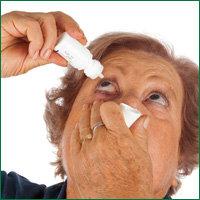 A new clinical trial showed positive results for patients with wet age-related macular degeneration (AMD). The study, which monitored the use and performance of Squalamine eye drops, showed improvement in a number of visual functions.
Conducted by Ohr Pharmaceutical, the nine-month research was a Phase II clinical trial that tested for the effectiveness of Squalamine eye drops in improving visual function. All patients had administered eye drops two times per day, either Squalamine or a placebo, plus injections of
Read More »
 A new study shows that omega-3 fatty acids could help with wet macular degeneration. Macular degeneration is expected to increase by 50% in older adults in industrialized countries by 2020. As the leading cause of vision loss in the elderly, it is a condition of serious significance. The macula is the central part of the retina. While it makes up only about 2% of the total retina, the brain devotes half of its visual processing network to information from the macula. It is responsible for central vision. The retina is a thin layer of nerves
Read More »
 As people age, eye diseases and conditions that commonly occur include macular degeneration, cataracts, vitreous tears/retinal tears and detachments, glaucoma, diabetic retinopathy, dry eyes, and eye floaters.
The question arises as to whether eye disease is inevitable with age. Will all older adults eventually have a “glint” in their eyes after cataracts surgery? More than 50% of people aged 75+ have glaucoma, cataracts, or macular degeneration. Can aging adults do anything to prevent, manage or slow down eye diseases associated with aging?
A large body of research is accumulating that shows the effects of regular eye exercises, good nutrition, and targeted supplementation on preventing and/or managing eye conditions. For instance, peer-reviewed research has shown that the risk of getting macular degeneration can be significantly reduced by taking fish oil and lutein on a daily basis. Vigorous exercise may reduce the incidence of glaucoma. And the effects of antioxidants on preventing cataract and macular degeneration have been the subject of significant research.
 Increase in the delivery of a treatment for neovascular age-related macular degeneration (wet AMD) has resulted in a significant 50% reduction of new cases of blindness in Denmark, according to a study published in the American Journal of Opthamology. Age-related macular degeneration is the most common cause of blindness in the West. Specifically, AMD patients lose reading vision and their ability to drive, resulting in revocation of their drivers’ license.
Wet AMD is the most serious type of macular degeneration. Abnormal blood vessels start to grow in the eye, toward the yellow spot in the middle of the retina called the macular. The macular provides the most visual acuity, as well as perception of color. Wet AMD results in quick and severe loss of vision.
Natural Eye Care, Inc.
3 Paradies Lane
New Paltz, New York 12561
Phone: 845.475.4158

NaturalEyeCare™ started in 1999 to help the public and professionals learn about complementary care in eye disease treatment.
The information and recommendations we offer are based on over 30 years of peer review research and personal clinical experience which guides us in providing a valuable resource to our readers, customers and patients regarding maintaining healthy vision naturally.
We believe that vision health is intimately connected to overall mental, physical and spiritual health. Therefore we encourage people to look at their overall lifestyle and diet as part of keeping healthy vision and reducing the risk of eye disease onset. This includes diet, regular exercise, and management of daily stress. If one has health issues such as high blood pressure, a thyroid imbalance, any autoimmune disease and/or are on medication(s), these possible contributions to eye disease should considered when working with your health care professional.
Please do not hesitate to call us at 845.475.4158 with any questions and concerns.