Your retina is the thin layer of light-sensing tissue at the back of your eye. It does the work of turning light into the pictures your brain sees. Basically, the way it works is light passes through the eye into the retina. The retina converts this light into signals and passes them to the optic nerve, which then sends the information to the visual cortex in the brain. We essentially see with our brain that interprets the data we receive.
The good news: everyday habits like what you eat, whether you smoke and how active you are can lower your risk of the most common threats to your retina and overall vision.
Why your retina deserves attention
Two diseases cause most retina-related vision loss, and both can do damage quietly before you notice any change. Glaucoma and cataracts, which affect the optic nerve and the lens, are also leading causes of vision loss as we age.
- Age-related macular degeneration (AMD) wears down the macula, the center of the retina you use for reading and recognizing faces. It is the leading cause of blindness in the Western world [3].
- Diabetic retinopathy happens when diabetes damages the retina’s tiny blood vessels. It is the leading cause of blindness in adults ages 20 to 74, and it usually has no early symptoms [2].
- Glaucoma is referred to as the “silent thief” because there are typically no symptoms felt until at one point, if left untreated, one suddenly notices reduced peripheral vision. Most cases of glaucoma are due to higher than normal levels of intraocular eye pressure (IOP), though there are also normal and low-tension glaucoma diagnoses where the issue may be more related to other health conditions and depletion of essential nutrients that support optic nerve health.
- Cataracts commonly start at ages 60+, but can begin in earlier years as well. Once they have developed to the point where they affect daily living activities, eye doctors often recommend lens replacement surgery.
None of these conditions can always be prevented, but research points to habits that tilt the odds in your favor. Numerous peer reviewed research studies show that diet, exercise, lifestyle considerations and targeted supplementation can play a significant role in both helping prevent or reduce the risk of eye disease, as well as being essential components of treatment strategies.
Seven Natural Habits for Healthier Vision
1. Eat the Mediterranean Way
In a study of nearly 5,000 older adults in Europe, people who closely followed a Mediterranean-style diet were 41% less likely to develop late AMD [4]. That means plenty of vegetables, fruit, legumes, whole grains, fish and olive oil, with less red meat. No single food made the difference; the overall eating pattern did. The National Eye Institute especially recommends dark leafy greens like spinach, kale and collards, plus fish such as salmon and tuna [7]. For more information on the Mediterranean Diet, go to https://naturaleyecare.com/articles/mediterranean-diet/
2. Don’t Smoke, and If You Do, Quit
In a 10-year Australian study, current smokers were about four times as likely as never-smokers to develop late AMD [3]. Quitting pays off over time: people who had been smoke-free for 20 years or more had a risk close to that of non-smokers [10].
3. Keep Blood Sugar, Blood Pressure and Cholesterol in Check
For people with diabetes, better blood sugar control slows the start and progression of diabetic retinopathy, and controlling blood pressure and cholesterol also lowers the risk of vision loss [6]. Healthy eating, regular exercise and taking medications as prescribed all help [1].
4. Move Your Body
A review of nine studies found that active people had 41% lower odds of late AMD than sedentary people [5]. Even about 3 hours a week of light-to-moderate activity, like brisk walking, was linked to a benefit [5].
5. Wear UV-Blocking Sunglasses Outdoors
Choose a pair that blocks at least 99% of UVA and UVB rays [7]. Their best-proven benefit is protecting the front of the eye from problems like cataracts, but it’s an easy habit that supports overall eye health.
6. Juicing at Home
If possible, juice daily or a few times a week. Use mostly green, leafy vegetables, then add your favorite fruits. For juicing recipes by eye condition, go to https://naturaleyecare.com/eye-disease-prevention/juicing-food-for-your-eyes/
7. Do Daily Eye Exercises
The muscles of our eyes are no different than the muscles in the rest of the body. Daily eye exercises help keep the eye muscles healthy and flexible, and support circulation and energy flow throughout the eyes. This is particularly relevant for those that spend many hours on the computer and/or cell phone, or read a lot where long hours of near vision are required, as well as for those 45+ years of age. As one ages typically past 45 years of age, the muscles of the eyes start to weaken, often referred to as Presbyopia or “middle aged vision” where one starts to hold reading materials further away to see them.
Note that eye doctors often prescribe glasses that maximize vision at that moment, but the eyes will tend to relax into the prescription, so that over time the weakened vision requires stronger glasses. Doing daily eye exercises not only helps stabilize vision, but in fact often improves vision, reducing the prescription needed. In vision therapy, the practitioner will often prescribe slightly weaker glasses, then have the patient do daily eye exercises until that prescription is now normal. In many cases, the prescription can then be reduced even further. To locate a Behavioral Optometrist or vision therapist near you, go to www.oep.org.
For our free eye exercise e-booklet, go to https://naturaleyecare.com/blog/download-your-free-eye-exercise-e-book/?_gl=1*qjwco*_gcl_au*MTM5MzQ3OTM0MC4xNzkzNjQ4MTU4
Most of this research shows associations, not proof of cause and effect. Still, these habits are good for your heart and overall health too, so there’s little downside.
What About Eye Vitamins?
When reviewing eye supplements to consider, there are many on the market. Make sure you purchase a brand from a reputable source to ensure both quality of production, and that you are getting what is described on the supplement labels.
When possible, we prefer and are oriented to whole food, organic, GMO or wild-crafted herbal formulas for maximum absorption. Try to get supplements that are free of allergens, and without fillers.
Catch Problems Early
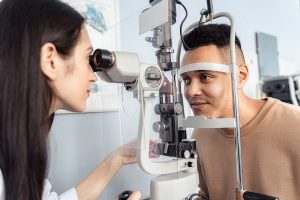
The most powerful habit can’t be done at home: a comprehensive dilated eye exam, in which drops widen your pupils so the doctor can see your retina.
- If you have diabetes, get a dilated exam at least once a year [1]. With early detection and timely treatment, the risk of severe vision loss from diabetic retinopathy can be cut by 95% [11].
- If you’re over 50 or AMD runs in your family, ask your eye doctor how often you should be checked. They may also suggest a simple home test, called an Amsler grid, to watch for changes between visits.
- Call an eye doctor right away if straight lines start to look wavy, a dark or blank spot appears in the center of your vision, or your vision suddenly blurs.
This newsletter is general information, not medical advice. Talk with your doctor before changing your diet, exercise routine or supplements.
Summary
There are many steps one can take to support long term vision and overall health. For overall eye wellness, visit our page at https://store.naturaleyecare.com/wellness
Suggested Supplements
Dr. Grossman’s Complete Eye Formula 2oz (oral spray) – easily absorbed essential nutrients for retinal and overall vision health.
Advanced Eye & Vision Support Formula (whole food) 60 vcaps – this formula is whole food, organic and GMO free with lutein, zeaxanthin, bilberry, and much more.
Retinal Support (wild-crafted herbal formula) 2 oz – based on classic Chinese Liver tonic. In Chinese medicine, the Liver “opens to the eyes”, so is the primary meridian (flow of energy) to support the free flow of circulation and energy throughout the eyes (and body as well).
Dr. Grossman’s Meso Plus Retinal Support and Computer Eye Strain Formula with Astaxanthin 90 vcaps – also contains lutein, zeaxanthin, meso-zeaxanthin, taurine and more.
Advanced Eye & Vision Support & Meso Plus Formula with Astaxanthin (3-mo. Combo)
Dr. Grossman’s Advanced Eye and Dr. G’s Whole Food Superfood Multi120 Vcap Combo – 2 months supply
Dr. Grossman’s Blood Vessel Control Formula 2oz
Dr. Grossman’s Bilberry/Ginkgo Combination 2oz (60ml)
NMN Wonderfeel Capsul 60 vegcaps
H2 Elite Molecular Hydrogen 60 tabs
Retinal Support Packages
AMD Package 1 (3-month supply)
Anti-Inflammatory Eye and Whole Body Package 1 (1 month supply)
Related Home Device
Microcurrent Stimulation 100ile Purchase Option – home unit for supporting retinal and optic nerve health. Summaries of 7 studies done to date summarized on the product page.
Recommended Books
Natural Parkinson’s Support (ebook): Your Guide to Preventing and Managing Parkinson’s
Sources
- NIH: Annual dilated eye exams during National Diabetes Month (2011)
- National Eye Institute: National Diabetes Month article (2018)
- Smoking and long-term risk of AMD, Blue Mountains Eye Study, Archives of Ophthalmology (2007)
- Mediterranean diet and 41% lower risk of advanced AMD, Ophthalmology (2018)
- Physical activity and AMD: systematic review and meta-analysis, American Journal of Ophthalmology (2017) and AAO EyeNet summary
- National Eye Institute: Protecting against vision loss from diabetes
- National Eye Institute: Tips to keep your eyes healthy
- NIH: AREDS2 10-year results (2022)
- What the AREDS trials actually showed
- Pack-years of smoking and AMD risk, British Journal of Ophthalmology (2006)
- NIH: Diabetic eye disease and early detection