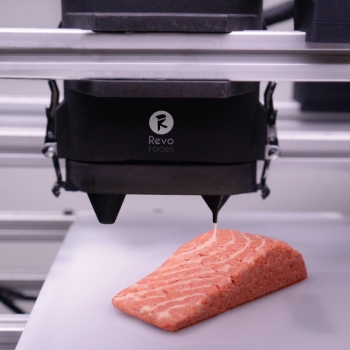
3D-printed foods are becoming increasingly commonplace. 3D-printed foods carry specific biological, chemical, and nutritional risks that differ from traditional cooking and food preparation.
The global 3D food printing market is expected to grow from USD 98.71 million in 2019 to USD 472.95 million by the end of 2025. Several 3D food printers are on the market today, including models designed for industrial production and for home or restaurant use. The Focus (By Flow, Eindhoven, The Netherlands) is a 3D printer for the manufacturing of pasty foods, which allows users to print out meals by downloading recipes. 1 2 3
Currently, identifying whether food has been 3D-printed is difficult because manufacturers are generally not required to label products as 3D-printed on the front of the package.
Potential Positives
Three-dimensional food printing offers potential benefits for food production, including modifying texture, enabling personalized nutrition, and adapting to specific consumers’ needs. It could present innovative, complex foods attractively, create uniquely textured foods tailored to patients with dysphagia, and support sustainability by reducing waste, using by-products, and incorporating eco-friendly ingredients. Several restaurants have used 3D food printers to provide customers with visually appealing food and unique dining experiences. 4 5
3D-printed food also supports sustainability. For example, researchers used fruits, vegetables, and insect proteins to create 3D-printed food that reduced food waste and CO2 emissions from livestock. Three-dimensional food printing may enhance food utilization and reduce food waste by using deformed vegetables and fruits that do not meet sale criteria, as well as vegetable and fruit or animal by-products, to make more palatable food products for consumers. 6 7
Modified-texture diets, such as thickened liquids and purees, could help patients with swallowing difficulties caused by stroke, head and neck cancer, and neuromuscular disorders prevent aspiration pneumonia and improve diet quality. Patients with swallowing difficulties often have inadequate calorie intake. 8 9 10 11
Antioxidants can be added to food through 3D printing and microencapsulation. 12
Consumers widely accept edible insects. Using insect powders in food formulations may be a feasible way to increase the nutritional density of food products and address undernourishment in the least developed countries.
Current 3D food applications include: chocolate, meat and meat alternatives, egg white protein objects, and fruit and vegetable smoothies. 13 14 15 16 17
Inkjet printing is used for low-viscosity materials, so it is primarily used for 2D printing, such as creating high-resolution images on cookies. 18 19
3D printing technology can produce foods that meet individual nutritional needs based on nutritional status, lifestyle, and dietary preferences. Imagine creating personalized foods based on individual nutritional needs: customized supplements, patient-oriented diets, and personalized probiotics. For example, foods or diets could be printed to reduce sodium and potassium content for patients with chronic kidney disease and to introduce high dietary fiber for obese patients. 20 21 22 23
Risks of Ingesting 3D-Printed Foods
To date, no large-scale clinical trials on the effects of 3D-printed food intake on patients’ nutritional status or diet quality have been published. Few studies have discussed the challenges and risks of 3D-printed foods in the health sector. 24
Since 3D-printed foods require pre- and post-processing of food materials, processing in a 3D printer, and may require food additives, they can be classified as ultra-processed foods. Current studies consistently show that ultra-processed foods are nutritionally unbalanced and that consuming them negatively affects dietary quality. 25 26 27 28
Ultra-processed foods lead to a stronger glycemic response and lower fullness satisfaction compared to raw and minimally processed foods, which could result in metabolic symptoms including heart disease, type 2 diabetes, and stroke. A cohort study investigated the association between ultra-processed food consumption and functional gastrointestinal disorders and found that a higher proportion of ultra-processed food in the diet was associated with a higher prevalence of irritable bowel syndrome. 29
Nutrients from ultra-processed foods may be absorbed in more proximal regions of the gut, which can lead to different gut–brain signals than those generated by the same nutrients from whole-food intake. 30
There are some significant concerns about ingesting these foods as follows:
Nutritional and Ultra-Processing Concerns
We discussed the health risks of regularly eating ultra-processed foods in prior blog posts.
- Ultra-Processed Structure: Transforming whole foods into smooth, extruded pastes can alter or destroy the natural food matrix. 31
- Loss of Bioavailability: Thermal processing during the printing or pre-heating stages can degrade heat-sensitive nutrients like vitamins B, C, and E, while heavy reliance on food additives, emulsifiers, and binders can shift 3D-printed meals into the category of ultra-processed foods.
- 3D food printing technology may destroy the original nutritional value of the food. Many chemical reactions and physical changes occur during processing and post-processing. For example, protein denaturation, starch gelatinization and fragmentation, and moisture reduction may change the final product’s nutritional value. 32 33 34 35
- In the clinical setting, 3D printed meals also face the challenge of reheating. These heating and cooling or reheating processes may make it easier for microorganisms to grow and affect food safety. 36
Microbiological Contamination and Bacterial Growth Concerns
Crevices and Layer Lines: 3D printed objects and specialized food nozzles feature tiny layer lines, microscopic gaps, and complex internal channels. These spaces trap food residue, moisture, and bacteria (E. coli, Salmonella, and Listeria) that are difficult to scrub away completely, even in a standard dishwasher. 37
Reheating and Holding Challenges: In clinical or hospital settings, 3D-printed meals often sit too long or undergo fluctuating heating and cooling cycles during extrusion and distribution. These conditions can spark microbial proliferation if safety protocols are missed.
Moisture-Rich Pastes: Edible pastes used in 3D printers (such as purées, dough, cheese, or chocolate) have high water activity. If stored or printed at improper temperatures, they can quickly become breeding grounds for pathogens.
Allergen and Cross-Contamination Risks
Shared Cartridges: Food printers often utilize multi-use or interchangeable syringes, tubes, and nozzles. If these components are not rigorously sanitized between batches, severe cross-contamination can occur, posing a hidden danger for people with severe food allergies. 38
Chemical Migration and Non-Food-Safe Materials
Toxic Filaments and Resins: Most standard 3D printer filaments (like ABS or standard photopolymer resins) are designed for mechanical strength or appearance rather than food safety. They may contain toxic chemical dyes, plasticizers, or heavy metal residues, such as lead or cadmium from nozzles, that leach into food. 39
Lack of Default Food Safety: Standard 3D printers and parts are not food-safe by default unless they use specialized stainless-steel components, certified food-grade materials, and food-safe epoxy or silicone sealants. 40
Chemical Migration: Prolonged contact between edible pastes and uncertified plastic surfaces increases the risk of chemical migration. Even relatively safe materials like PLA can degrade, crack, or harbor mold when exposed to heat or harsh cleaning agents. 41
Summary
Incorporating 3D-printed foods offers several advantages, particularly in developing countries where whole foods are less readily available, and the risk of starvation is higher. That said, we recommend eating whole foods raw or lightly steamed, or in stews, purees, and soups.
When possible, we recommend whole-food, organic, GMO-free supplements to complement your diet, targeted to specific health issues and to reduce future health risks.
For juicing recipes by eye condition, go to https://naturaleyecare.com/eye-disease-prevention/juicing-food-for-your-eyes/
For diet recommendations such as the Mediterranean Diet, go to https://naturaleyecare.com/articles/mediterranean-diet/
- Reportlinker 3D Food Printing Market Research Report by Ingredient, by Vertical—Global Forecast to 2025—Cumulative Impact of COVID-19. 2020. ↩
- Mantihal S., Kobun R., Lee B.-B. 3D food printing of as the new way of preparing food: A review. Int. J. Gastron. Food Sci. 2020;22:100260. doi: 10.1016/j.ijgfs.2020.100260 ↩
- ByFlow What Can Patissiers & Chocolatiers Do with It? 2020. (accessed on 26 June 2023). ↩
- Baiano A. 3D Printed Foods: A Comprehensive Review on Technologies, Nutritional Value, Safety, Consumer Attitude, Regulatory Framework, and Economic and Sustainability Issues. Food Rev. Int. 2020;38:986–1016. doi: 10.1080/87559129.2020.1762091. ↩
- Rubio E., Hurtado S. 3D Food Printing Technology at Home, Domestic Application. In: Godoi F.C., Bhandari B.R., Prakash S., Zhang M., editors. Fundamentals of 3D Food Printing and Applications. Academic Press; Cambridge, MA, USA: 2019. pp. 289–329 ↩
- Ramundo L., Otcu G.B., Terzi S. Sustainability Model for 3D Food Printing Adoption; Proceedings of the 2020 IEEE International Conference on Engineering, Technology and Innovation (ICE/ITMC); Cardiff, UK. 15–17 June 2020; pp. 1–9 ↩
- Severini C., Azzollini D., Albenzio M., Derossi A. On printability, quality and nutritional properties of 3D printed cereal based snacks enriched with edible insects. Food Res. Int. 2018;106:666–676. doi: 10.1016/j.foodres.2018.01.034. ↩
- Alagiakrishnan K., Bhanji R.A., Kurian M. Evaluation and management of oropharyngeal dysphagia in different types of dementia: A systematic review. Arch. Gerontol. Geriatr. 2013;56:1–9. doi: 10.1016/j.archger.2012.04.011. ↩
- Huang K.L., Liu T.Y., Huang Y.C., Leong C.P., Lin W.C., Pong Y.P. Functional outcome in acute stroke patients with oropharyngeal Dysphagia after swallowing therapy. J. Stroke Cerebrovasc. Dis. 2014;23:2547–2553. doi: 10.1016/j.jstrokecerebrovasdis.2014.05.031. ↩
- ouzani A.Z., Adams S., Whyte D.J., Oliver R., Hemsley B., Palmer S., Balandin S. DesTech Conference Proceedings. KnE Publishing; Dubai, United Arab Emirates: 3D printing of food for people with swallowing difficulties. ↩
- Pedersen A., Wilson J., McColl E., Carding P., Patterson J. Swallowing outcome measures in head and neck cancer—How do they compare? Oral Oncol. 2016;52:104–108. doi: 10.1016/j.oraloncology.2015.10.015. ↩
- Vieira M.V., Oliveira S.M., Amado I.R., Fasolin L.H., Vicente A.A., Pastrana L.M., Fuciños P. 3D printed functional cookies fortified with Arthrospira platensis: Evaluation of its antioxidant potential and physical-chemical characterization. Food Hydrocoll. 2020;107:105893. doi: 10.1016/j.foodhyd.2020.105893. ↩
- Lanaro M., Forrestal D.P., Scheurer S., Slinger D.J., Liao S., Powell S.K., Woodruff M.A. 3D printing complex chocolate objects: Platform design, optimization and evaluation. J. Food Eng. 2017;215:13–22. doi: 10.1016/j.jfoodeng.2017.06.029. ↩
- Dick A., Bhandari B., Prakash S. 3D printing of meat. Meat Sci. 2019;153:35–44. doi: 10.1016/j.meatsci.2019.03.005. ↩
- Handral H.K., Hua Tay S., Wan Chan W., Choudhury D. 3D Printing of cultured meat products. Crit. Rev. Food Sci. Nutr. 2022;62:272–281. doi: 10.1080/10408398.2020.1815172. ↩
- Liu L., Yang X., Bhandari B., Meng Y., Prakash S. Optimization of the Formulation and Properties of 3D-Printed Complex Egg White Protein Objects. Foods. 2020;9:164. doi: 10.3390/foods9020164. ↩
- Severini C., Derossi A., Ricci I., Caporizzi R., Fiore A. Printing a blend of fruit and vegetables. New advances on critical variables and shelf life of 3D edible objects. J. Food Eng. 2018;220:89–100. doi: 10.1016/j.jfoodeng.2017.08.025. ↩
- Nachal N., Moses J.A., Karthik P., Anandharamakrishnan C. Applications of 3D Printing in Food Processing. Food Eng. Rev. 2019;11:123–141. doi: 10.1007/s12393-019-09199-8. ↩
- Pallottino F., Hakola L., Costa C., Antonucci F., Figorilli S., Seisto A., Menesatti P. Printing on Food or Food Printing: A Review. Food Bioprocess Technol. 2016;9:725–733. doi: 10.1007/s11947-016-1692-3. ↩
- Caulier S., Doets E., Noort M. An exploratory consumer study of 3D printed food perception in a real-life military setting. Food Qual. Prefer. 2020;86 doi: 10.1016/j.foodqual.2020.104001. ↩
- Keerthana K., Anukiruthika T., Moses J.A., Anandharamakrishnan C. Development of fiber-enriched 3D printed snacks from alternative foods: A study on button mushroom. J. Food Eng. 2020;287:110116. doi: 10.1016/j.jfoodeng.2020.110116. ↩
- Sun J., Peng Z., Zhou W., Fuh J.Y.H., Hong G.S., Chiu A. A Review on 3D Printing for Customized Food Fabrication. Procedia Manuf. 2015;1:308–319. doi: 10.1016/j.promfg.2015.09.057. ↩
- Burke-Shyne S., Gallegos D., Williams T. 3D food printing: Nutrition opportunities and challenges. Br. Food J. 2020;123:649–663. doi: 10.1108/BFJ-05-2020-0441. ↩
- Hemsley B., Palmer S., Kouzani A., Adams S., Balandin S. Review informing the design of 3D food printing for people with swallowing disorders: Constructive, conceptual, and empirical problems; Proceedings of the System Sciences Conference; Honolulu, HI, USA. 8–11 January 2019 ↩
- Kim H.W., Bae H., Park H.J. Reprint of: Classification of the printability of selected food for 3D printing: Development of an assessment method using hydrocolloids as reference material. J. Food Eng. 2018;220:28–37. doi: 10.1016/j.jfoodeng.2017.10.023 ↩
- Adams J., White M. Characterisation of UK diets according to degree of food processing and associations with socio-demographics and obesity: Cross-sectional analysis of UK National Diet and Nutrition Survey (2008–12) Int. J. Behav. Nutr. Phys. Act. 2015;12:160. doi: 10.1186/s12966-015-0317-y. ↩
- Costa Louzada M.L., Martins A.P., Canella D.S., Baraldi L.G., Levy R.B., Claro R.M., Moubarac J.C., Cannon G., Monteiro C.A. Ultra-processed foods and the nutritional dietary profile in Brazil. Rev. Saude Publica. 2015;49:38. doi: 10.1590/S0034-8910.2015049006132. ↩
- Martinez Steele E., Baraldi L.G., Louzada M.L., Moubarac J.C., Mozaffarian D., Monteiro C.A. Ultra-processed foods and added sugars in the US diet: Evidence from a nationally representative cross-sectional study. BMJ Open. 2016;6:e009892. doi: 10.1136/bmjopen-2015-009892. ↩
- Schnabel L., Buscail C., Sabate J.M., Bouchoucha M., Kesse-Guyot E., Alles B., Touvier M., Monteiro C.A., Hercberg S., Benamouzig R., et al. Association Between Ultra-Processed Food Consumption and Functional Gastrointestinal Disorders: Results From the French NutriNet-Sante Cohort. Am. J. Gastroenterol. 2018;113:1217–1228. doi: 10.1038/s41395-018-0137-1. ↩
- Moubarac J.C., Batal M., Louzada M.L., Martinez Steele E., Monteiro C.A. Consumption of ultra-processed foods predicts diet quality in Canada. Appetite. 2017;108:512–520. doi: 10.1016/j.appet.2016.11.006. ↩
- Zhu W, Iskandar MM, Baeghbali V, Kubow S. Three-Dimensional Printing of Foods: A Critical Review of the Present State in Healthcare Applications, and Potential Risks and Benefits. Foods. 2023 Sep 1;12(17):3287. doi: 10.3390/foods12173287. PMID: 37685220; PMCID: PMC10487194. ↩
- Brunner T.A., Delley M., Denkel C. Consumers’ attitudes and change of attitude toward 3D-printed food. Food Qual. Prefer. 2018;68:389–396. doi: 10.1016/j.foodqual.2017.12.010. ↩
- Lupton D., Turner B. Food of the Future? Consumer Responses to the Idea of 3D-Printed Meat and Insect-Based Foods. Food Foodways. 2018;26:269–289. doi: 10.1080/07409710.2018.1531213 ↩
- Gosine L., Kean B., Parsons C., McSweeney M.B. Using a 3D food printer as a teaching tool: Focus groups with dietitians, teachers, and nutrition students. J. Food Sci. Educ. 2020;20:18–25. doi: 10.1111/1541-4329.12216 ↩
- Sun J., Zhou W., Yan L., Huang D., Lin L.-Y. Extrusion-based food printing for digitalized food design and nutrition control. J. Food Eng. 2018;220:1–11. doi: 10.1016/j.jfoodeng.2017.02.028. ↩
- Dankar I., Haddarah A., Omar F.E.L., Sepulcre F., Pujolà M. 3D printing technology: The new era for food customization and elaboration. Trends Food Sci. Technol. 2018;75:231–242. doi: 10.1016/j.tifs.2018.03.018. ↩
- Scerra M., Barrett A., Eswaranandam S., Okamoto M. Effects of 3D Printing and Thermal Post Processing on the Stability of Vitamin E Acetate. J. Acad. Nutr. Diet. 2018;118:A148. doi: 10.1016/j.jand.2018.08.101. ↩
- https://www.sftrainings.org/3d-printed-food-a-novelty-or-a-health-risk/ ↩
- https://formlabs.com/blog/guide-to-food-safe-3d-printing/ ↩
- https://jlc3dp.com/blog/food-safe ↩
- https://www.reddit.com/r/3Dprinting/comments/1v0t31o/ann_reardon_tests_food_safety_of_3d_prints/ ↩