
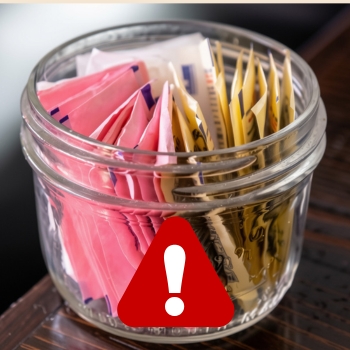
 Research on the dangers of artificial sweeteners continues to roll out. A 2026 Tufts University review and meta-analysis compared studies of artificial and low-calorie sweeteners with non-caloric options. 1 The researchers found that artificial sweeteners increased fasting insulin and HbA1c numbers, and tended to reduce insulin sensitivity. Additionally, they pointed to how artificial sweeteners change the gut microbiome as a possible culprit.
Non-nutritive, artificial sweeteners are FDA-approved, low-calorie alternatives to sugar. They can be synthetic or naturally derived and are found in a range of products, from diet soda to protein bars to sugar-free gum. They are also used as coffee sweeteners.
Multiple studies have shown various side effects associated with the use of these sweeteners. These side effects include gastrointestinal symptoms, 2 neurologic (damage) 3 and taste perception changes, 4 allergic reactions, 5 insulin and metabolic effects, 6 and cardiovascular effects. 7
Vision Health and Artificial Sweeteners
Gut Microbiome Changes
Frequent use of artificial sweeteners, especially aspartame and sweeteners commonly used in diet sodas, may be a concern for people with diabetes. Some research has associated higher intake with a greater risk of serious diabetic eye problems, including proliferative diabetic retinopathy (PDR). In sensitive individuals, aspartame byproducts may also be connected with visual symptoms or added stress on the optic nerve.
A Tufts University review in Current Atherosclerosis Reports found that artificial sweeteners may affect health in several harmful ways, including: 8
- Being linked to high fasting insulin levels and a higher HbA1c, along with reduced insulin sensitivity
- A higher risk of cardiometabolic conditions such as type 2 diabetes and heart disease
One of the main concerns is how no-calorie sweeteners affect the gut microbiome balance. Non-nutritive sweeteners generally pass through the gut and come into direct contact with gut microbes. One trial included in the review used detailed microbiome testing, along with experiments that transferred human gut microbes into mice. In that study, certain low-calorie sweeteners changed both the makeup of the gut microbiome and the way those microbes functioned.
A 2025 study found that higher intake of certain low- and no-calorie sweeteners, including aspartame, saccharin, acesulfame K, erythritol, sorbitol, and xylitol, was associated with faster decline in overall cognition. The strongest changes were seen in memory and verbal fluency. When the sweeteners were studied together, higher total intake was linked with faster decline in verbal fluency and overall cognition among participants without diabetes, and faster decline in memory and overall cognition among participants with diabetes. 9
Diabetes and Diabetic Retinopathy
A study published online in Clinical and Experimental Ophthalmology found a link between frequent diet soda intake and proliferative diabetic retinopathy (PDR) in adults with diabetes. Participants who drank more than four cans of diet soda per week had nearly twice the risk of PDR compared with those who drank less or none. 10
A landmark study published in the European Heart Journal in June 2024 found that people with higher blood levels of xylitol had a significantly greater risk of heart attack, stroke, and death. 11 The same research team reported similar concerns with erythritol, another sugar alcohol often used in “natural” sugar-free products.
Other research has also raised questions about the effects artificial sweeteners may have on glucose intolerance. 12 Overall, these findings add to growing evidence that regular, frequent use of artificially sweetened beverages may have negative vascular effects and may be linked with higher body mass index and greater cardiometabolic risk. 13
Participants who consumed xylitol-sweetened beverages showed a 1,000-fold increase in blood xylitol levels, leading to greater platelet reactivity-a key risk factor for microvascular events such as strokes and heart attacks.
This matters for eye health. Platelet overactivity and vascular inflammation are also driving forces behind higher risk of and onset of:
- Macular degeneration
- Glaucoma progression
- Diabetic retinopathy
- Retinal vein occlusion
How Do Artificial Sweeteners Disrupt Gut Health?
Artificial sweeteners may disturb the balance of the gut microbiome, the community of bacteria and other microbes living in the intestines. This disruption may contribute to digestive symptoms such as bloating and gas, increase intestinal permeability, sometimes called “leaky gut,” and play a role in temporary blood sugar spikes. 14 15
Synthetic sweeteners such as Sucralose, Saccharin and Aspartame are largely indigestible and pass through most of the GI tract unchanged. However, studies suggest that they can decrease beneficial bacteria like Lactobacillus and Bifidobacterium and increase harmful strains. In some individuals, this dysbiosis has been linked to systemic inflammation and reduced blood sugar control. 16
Alternatives to Artificial Sweeteners
Monk fruit extract is a natural, zero-calorie sweetener that does not appear to raise blood sugar levels. It may also be gentler on the gut microbiome than some artificial sweeteners.
Natural honey offers a natural source of sweetness with antioxidants and antimicrobial properties.
Maple syrup contains beneficial minerals like zinc and manganese, with a rich flavor that complements many dishes.
Coconut sugar has a lower glycemic index than regular table sugar and contains small amounts of minerals such as iron, zinc, calcium, and potassium. However, it is still a form of sugar and should be used in moderation.
Raw stevia or pure stevia, unlike processed stevia, has a minimal impact on gut health.
Suggested Supplements
Dr. Grossman’s Complete Eye Formula 2oz (oral spray)
Dr. Grossman’s Complete Eye (oral Spray)/Meso Plus Combo Package
Advanced Eye & Vision Support Formula (whole food) 60 vcaps
Dr. Grossman’s Meso Plus Retinal Support and Computer Eye Strain Formula with Astaxanthin 90 vcaps
Dr. Grossman’s Advanced Eye and Dr. G’s Whole Food Superfood Multi1 20 Vcap Combo – 2 months supply
ReVision Formula (wild-crafted herbal formula) 2 oz – based on classic Chinese medicine Liver tonic formula to help support healthy circulation and blood flow throughout the eyes and body.
Dr. Grossman’s Blood Vessel Control Formula 2oz – helps reduce the risk of unwanted blood vessel growth, supports healthy circulation, reduces inflammation, and more.
Dr. Grossman’s Premium Turmeric Vcaps (Organic)
Brain and Memory Power Boost 120 caps
Packages
Brain and Memory Support Package 1
AMD Package 1 (3-month supply)
Sugar Balance & Blood Vessel Support Package 1 (1 month)
Recommended Books
Natural Eye Care: Your Guide to Healthy Vision and Healing – on backorder for 2-3 weeks
Natural Parkinson’s Support: Your Guide to Preventing and Managing Parkinson’s
- Wang, M., Wu, O.Y., Wallen, O. et al. Artificial and Other Non-Nutritive Sweeteners, the Microbiome, and Cardiometabolic Health. Curr Atheroscler Rep 28 , 65 (2026). https://doi.org/10.1007/s11883-026-01429-9 ↩
- Artificial sweeteners: a systematic review and primer for gastroenterologists. Spencer M, Gupta A, Dam LV, Shannon C, Menees S, Chey WD. J Neurogastroenterol Motil. 2016;22:168-180. doi: 10.5056/jnm15206. ↩
- Aspartame as a dietary trigger of headache. Lipton RB, Newman LC, Cohen JS, Solomon S. Headache. 1989;29:90-92. doi: 10.1111/j.1526-4610.1989.hed2902090.x ↩
- The effect of artificial sweeteners use on sweet taste perception and weight loss efficacy: a review. Wilk K, Korytek W, Pelczyńska M, Moszak M, Bogdański P. Nutrients. 2022;14:1261. doi: 10.3390/nu14061261. ↩
- A case of allergic urticaria caused by erythritol. Hino H, Kasai S, Hattori N, Kenjo K. J Dermatol. 2000;27:163-165. doi: 10.1111/j.1346-8138.2000.tb02143.x. ↩
- Effect of artificial sweeteners on insulin resistance among type-2 diabetes mellitus patients. Mathur K, Agrawal RK, Nagpure S, Deshpande D. J Family Med Prim Care. 2020;9:69-71. doi: 10.4103/jfmpc.jfmpc_329_19. ↩
- Artificial sweeteners and risk of cardiovascular diseases in the prospective NutriNet-Santé cohort. Debras C, Chazelas E, Sellem L, et al. Eur J Public Health. 2022;32:0. doi: 10.1136/bmj-2022-071204 ↩
- Caputo J. Growing evidence that sugar substitutes disrupt gut health and metabolism (Internet). Tufts Now. 2026 Jun 30 (cited 2026 Jul 15). Available from: https://now.tufts.edu/2026/06/30/growing-evidence-sugar-substitutes-disrupt-gut-health-and-metabolism ↩
- Gomes Gonçalves N, Martinez-Steele E, Lotufo PA, Bensenor I, Goulart AC, Barreto SM, Giatti L, de Faria CP, Molina MDCB, Caramelli P, Marchioni DM, Suemoto CK. Association Between Consumption of Low- and No-Calorie Artificial Sweeteners and Cognitive Decline: An 8-Year Prospective Study. Neurology. 2025 Dec 9;105(11):e214393. doi:10.1212/WNL.0000000000214393. Epub 2025 Nov 6. PMID: 41197106. ↩
- Fenwick EK, Gan AT, Man RE, Sabanayagam C, Gupta P, Khoo K, Aravindhan A, Wong TY, Lamoureux EL. Diet soft drink is associated with increased odds of proliferative diabetic retinopathy. Clin Exp Ophthalmol. 2018 Sep;46(7):767-776. doi: 10.1111/ceo.13154. Epub 2018 Feb 23. PMID: 29360260. ↩
- Marco Witkowski, Ina Nemet, Xinmin S Li, Jennifer Wilcox, Marc Ferrell, Hassan Alamri, Nilaksh Gupta, Zeneng Wang, Wai Hong Wilson Tang, Stanley L Hazen, Xylitol is prothrombotic and associated with cardiovascular risk, European Heart Journal, Volume 45, Issue 27, 14 July 2024, Pages 2439-2452, https://doi.org/10.1093/eurheartj/ehae244 ↩
- Doctrow B. Xylitol may affect cardiovascular health (Internet). National Institutes of Health; 2024 Jun 25 (cited 2026 Jul 17). Available from: https://www.nih.gov/news-events/nih-research-matters/xylitol-may-affect-cardiovascular-health ↩
- Fenwick EK, Gan ATL, Man REK, Sabanayagam C, Gupta P, Khoo K, Aravindhan A, Wong TY, Lamoureux EL. Diet soft drink is associated with increased odds of proliferative diabetic retinopathy. Clin Exp Ophthalmol. 2018;46(7):767-776. doi:10.1111/ceo.13154. ↩
- Hetta HF, Sirag N, Elfadil H, Salama A, Aljadrawi SF, Alfaifi AJ, Alwabisi AN, AbuAlhasan BM, Alanazi LS, Aljohani YA, Ramadan YN, Abd Ellah NH, Algammal AM. Artificial Sweeteners: A Double-Edged Sword for Gut Microbiome. Diseases. 2025 Apr 15;13(4):115. doi:10.3390/diseases13040115. PMID: 40277825; PMCID: PMC12025785. ↩
- Ghusn W, Naik R, Yibirin M. The Impact of Artificial Sweeteners on Human Health and Cancer Association: A Comprehensive Clinical Review. Cureus. 2023 Dec 29;15(12):e51299. doi:10.7759/cureus.51299. PMID: 38288206; PMCID: PMC10822749. ↩
- Newman T. Do artificial sweeteners affect your gut bacteria? (Internet). ZOE; updated 2025 Nov 12 (cited 2026 Jul 17). Available from: https://zoe.com/learn/artificial-sweeteners-gut-bacteria ↩
