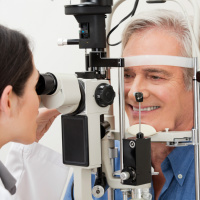
 Ocular Coherence Tomography (OCT) is a powerful technology for diagnosing and monitoring common eye diseases. Though the technology has existed for many years, it has not previously been available to a large number of optometry practices. Now, however, patients are getting access to OCT scans in more offices as a result of technological improvements and lower costs.
OCT creates images and measures the tissue structures of the eye by a process similar to ultrasound, but with light instead of sound. The patient simply rests his or her chin onto a chin rest and looks into a blue light.
The OCT scans the eye, producing 26,000 scans each second. These scans can show cross-sections and 3D views of different areas of the retina which may be causing problems. The OCT also easily measures thickness, which can be a key indicator for disease.Patients seeking this type of scan may suspect or already show signs of eye disease, such as glaucoma, wet or dry macular degeneration, or macular edema, to name a few. The level of advanced, close-up, and highly accurate imaging that the OCT provides can allow doctors to detect disease earlier and treat it more effectively.