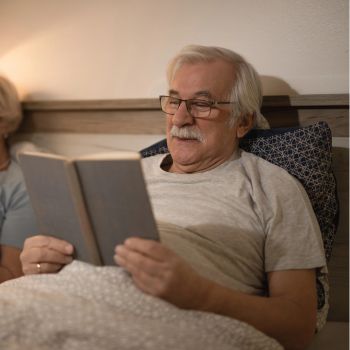
 Reading at night is recommended for health and improved sleep, compared with staring at electronic screens. Studies show that nighttime reading can improve sleep quality, lower stress, and reduce exposure to blue light, which can disrupt melatonin.1 Using phones, laptops, tablets, and televisions close to bedtime can make it tougher to drift off. The blue-leaning light they emit can interfere with your body’s natural “time to sleep” signals.2
Summary of the study:
- After exposure to red light (at both intensities), participants experienced an average of 4.5 unnoticed awakenings.
- High-intensity blue light resulted in as many as 7.6 awakenings.
- Low-intensity blue light resulted in 6.7 awakenings.
Benefits of Reading
Get Better Sleep By Reading
One study showed that blue light disrupted the production of melatonin and shortened sleep duration by approximately 16 minutes. It also significantly disrupted the continuity of sleep.1
Reading Reduces Stress
In a study by the University of Sussex, cognitive neuropsychologist Dr. David Lewis found that reading reduced stress more than any other traditional method of relaxation. Reading helped relax participants the most, reducing stress levels by 68%. It helped lower stress more than listening to music (stress reduction of 61%), taking a walk (42%), and playing video games (21%). Reading helps relieve tension, lowers the heart rate, relaxes muscles, and distracts the mind from the worries of the day.4
Readers Live Longer
Reading has even been linked to longevity. In a 2016 study of 3,635 people aged 50 and older, those who spent time reading books lived almost two years longer on average than those who did not read at all.5
Books Don’t Emit Blue Light
A 2015 study concluded that reading on a light-emitting device such as a phone or tablet can disrupt sleep by stimulating blue light. It can interfere with your body’s production of melatonin, reduce REM sleep, keep you awake longer, delay your circadian rhythm, and leave you less alert in the morning.2 Paper books don’t emit blue light. If you prefer reading ebooks, use a tablet or e-reader with Night Mode. Or, add a blue-light filter to your screen, such as Night Shift, Night Light, or f.lux, to warm the screen and cut blue light.
Other Benefits of Reading At Bedtime
- Increases your vocabulary
- Protects against age-related cognitive decline
- Boosts empathy
For those with partial vision loss or difficulty reading, audiobooks can provide similar wind-down benefits.
Bedtime Reading Prep Tips
Think about your setup. If you have the space, carve out a cozy reading spot with a few pillows, a blanket, and gentle lighting so your body starts winding down as soon as you sit down.
Handle bedtime basics first. Knock out your routine, wash up, brush your teeth, and apply skincare before you start reading. That way, when the book starts making you drowsy, you can simply close it and settle in without getting back up.
Choose sleep-friendly lighting. Try dimming or switching off harsh overhead lights about two hours before bed. In the evening, warmer tones (like amber) are usually better than cool, blue-toned light. If you read with a lamp, an amber bulb can help keep things calm and low-glow. Consider buying blue-light-blocking glasses for nighttime reading.
Add a relaxing vibe. If it helps you unwind, quietly play some instrumental background sound and try aromatherapy. Common relaxing scents include lavender, chamomile, and peppermint.
Sleep and Vision Health
Chronic sleep deprivation can affect the eyes in many ways, ranging from everyday problems like dry eye, light sensitivity, and eyelid/eye muscle twitching to more serious concerns such as glaucoma and anterior ischemic optic neuropathy. It has also been linked to a higher risk of age-related macular degeneration (AMD), potentially due to increased oxidative stress and inflammation in the body.7 8
Macular Degeneration and Sleep
Researchers have proposed several mechanisms by which sleep may influence AMD risk. Melatonin production is naturally stimulated by darkness. One theory is that changes in sleep duration could disrupt the production of this hormone. Melatonin has been suggested to help protect retinal cells from oxidative damage and support healthy mitochondrial function.9
Another hypothesis involves the eye’s internal “cleanup” processes. During sleep, the glymphatic system is thought to help clear neurotoxic waste from the brain and possibly the retina as well. When sleep is disrupted, that clearance may become less efficient, allowing harmful metabolites to accumulate and potentially contribute to retinal damage over time.10 11
Observational research supports this connection. A 2022 study reported that sleep duration is associated with AMD risk. Longer sleep was associated with a lower risk, while shorter sleep was associated with a higher risk.12 A 2020 observational study reported similar findings.13
Poor Sleep Has Additional Detrimental Effects on the Eyes
Poor quality sleep has also been associated with increased risk of diabetic retinopathy, general vision impairment, dry eye disease, myopia, and cataracts.14 15 16 17
Suggested Supplements
Dr. Grossman’s Complete Eye Formula 2oz (oral spray)
Dr. Grossman’s Complete Eye (oral Spray)/Meso Plus Combo Package
Advanced Eye & Vision Support Formula (whole food) 60 vcaps – our foundation eye formula, which is a whole food, organic, GMO-free formulation.
Dr. Grossman’s Meso Plus Retinal Support and Computer Eye Strain Formula with Astaxanthin 90 vcaps – with lutein, zeaxanthin, meso-zeaxanthin and astaxanthin.
Dr. Grossman’s Advanced Eye and Dr. G’s Whole Food Superfood Multi1 20 Vcap Combo – 2 months supply
Dr. Grossman’s Blood Vessel Control Formula 2oz
Nitric Oxide Supplement – helps promote increased oxygen throughout the body and eyes.
H2 Elite Molecular Hydrogen 60 tabs
Brain and Memory Power Boost 120 caps
Cognirev Extra Strength 2 oz Oral Spray
OmegaGenics™ EPA-DHA 720 Lemon 120 gels – also available in 240 gelcaps or liquid.
Packages
Brain and Memory Support Package 1
AMD Package 1 (3-month supply)
Sugar Balance & Blood Vessel Support Package 1 (1 month)
Recommended Books
Natural Eye Care: Your Guide to Healthy Vision and Healing
Natural Parkinson’s Support: Your Guide to Preventing and Managing Parkinson’s
- ScienceDaily. “Blue light exposure may affect sleep quality, study suggests.” August 22, 2017. https://www.sciencedaily.com/releases/2017/08/170822103434.htm ↩
- Chang, Anne-Marie, Daniel Aeschbach, Jeanne F. Duffy, and Charles A. Czeisler. “Evening use of light-emitting eReaders negatively affects sleep, circadian timing, and next-morning alertness.” Proceedings of the National Academy of Sciences 112, no. 4 (2015): 1232-1237. https://www.pnas.org/doi/10.1073/pnas.1418490112 ↩
- ScienceDaily. “Blue light exposure may affect sleep quality, study suggests.” August 22, 2017. https://www.sciencedaily.com/releases/2017/08/170822103434.htm ↩
- Smith, Nicola. “Reading can help reduce stress.” The Telegraph. March 30, 2009. https://www.telegraph.co.uk/news/health/news/5070874/Reading-can-help-reduce-stress.html ↩
- Bavishi, Avni, Martin D. Slade, and Becca R. Levy. “A chapter a day: Association of book reading with longevity.” Social Science & Medicine 164 (September 2016): 44-48. ↩
- Chang, Anne-Marie, Daniel Aeschbach, Jeanne F. Duffy, and Charles A. Czeisler. “Evening use of light-emitting eReaders negatively affects sleep, circadian timing, and next-morning alertness.” Proceedings of the National Academy of Sciences 112, no. 4 (2015): 1232-1237. https://www.pnas.org/doi/10.1073/pnas.1418490112 ↩
- Colak, E., N. Majkic-Singh, L. Zoric, A. Radosavljevic, and N. Kosanovic-Jakovic. “The role of CRP and inflammation in the pathogenesis of age-related macular degeneration.” Biochemia Medica (Zagreb) 22 (2012): 39-48. https://doi.org/10.11613/bm.2012.005 ↩
- Irwin, Michael R. “Sleep and inflammation: Partners in sickness and in health.” Nature Reviews Immunology 19 (2019): 702-715. https://doi.org/10.1038/s41577-019-0190-z ↩
- Tosini, Gianluca, Kazuyuki Baba, Chul Kim Hwang, and P. Michael Iuvone. “Melatonin: An underappreciated player in retinal physiology and pathophysiology.” Experimental Eye Research 103 (2012): 82-89. https://doi.org/10.1016/j.exer.2012.08.009 ↩
- Chong, P. L. H., D. Garic, M. D. Shen, I. Lundgaard, and A. J. Schwichtenberg. “Sleep, cerebrospinal fluid, and the glymphatic system: A systematic review.” Sleep Medicine Reviews 61 (2022): 101572. https://doi.org/10.1016/j.smrv.2021.101572 ↩
- Magonio, F. “REM phase: An ingenious mechanism to enhance clearance of metabolic waste from the retina.” Experimental Eye Research 214 (2022): 108860. https://doi.org/10.1016/j.exer.2021.108860 ↩
- Grover, S., and M. Sharma, International Age-related Macular Degeneration Genomics Consortium. “Sleep, pain, and neurodegeneration: A Mendelian randomization study.” Frontiers in Neurology 13 (2022): 765321. https://doi.org/10.3389/fneur.2022.765321 ↩
- Tsai, D. C., H. C. Chen, H. B. Leu, S. J. Chen, N. W. Hsu, C. C. Huang, et al. “The association between clinically diagnosed insomnia and age-related macular degeneration: A population-based cohort study.” Acta Ophthalmologica 98 (2020): e238-e244. https://doi.org/10.1111/aos.14238 ↩
- Mersha, G. A., D. S. Alemu, M. G. Ferede, et al. “Association of poor quality of sleep with vision-threatening diabetic retinopathy: A matched case-control study.” Ophthalmology and Therapy (2023). https://doi.org/10.1007/s40123-023-00663-7 ↩
- Sun, M., Q. Bo, B. Lu, X. Sun, and M. Zhou. “The association of sleep duration with vision impairment in middle-aged and elderly adults: Evidence from the China Health and Retirement Longitudinal Study.” Frontiers in Medicine (Lausanne) 8 (2021): 778117. https://doi.org/10.3389/fmed.2021.778117 ↩
- Au, N. H., R. Mather, A. To, and M. S. Malvankar-Mehta. “Sleep outcomes associated with dry eye disease: A systematic review and meta-analysis.” Canadian Journal of Ophthalmology 54 (2019): 180-189. https://doi.org/10.1016/j.jcjo.2018.03.013 ↩
- Zhou, M., D. L. Li, J. Y. Kai, X. F. Zhang, and C. W. Pan. “Sleep duration and the risk of major eye disorders: A systematic review and meta-analysis.” Eye (London) (2023). https://doi.org/10.1038/s41433-023-02403-4 ↩