
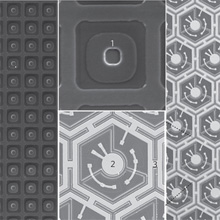
 Experimental research at Stanford University school of medicine may result in the restoration of vision for people whose sight has been lost due to Age-Related Macular Degeneration (ARMD), Retinitis Pigmentosa and other diseases of the retina. Surgeons plan to implant small solar panel-like cells under the retina. When the patient wears a special type of goggles, a camera and small computer will allow them to see the world around them again.
The goggles will have a tiny camera and a small computer. The computer will process data from the camera and display images on an LCD (liquid crystal micro-display) on the goggles. The images on the LCD are beamed using laser pulses of IR-A (near-infrared) light to tiny photovoltaic silicon chips implanted under the retina. The electrical currents from the chips’ photodiodes would trigger signals in the retina. From the retina, the message would flow to the brain, giving the patient the ability to see.
Tests are currently being conducted on animals, and human trials may begin in the near future.Similar to solar panels that are used to generate electricity on a large scale, these tiny solar panel-like cells convert light into electric current. Electrical activity in the retina is interpreted by the brain: therefore, solar cells should be able to aid in restoring vision.
This type of implant takes a novel approach that is more efficient than other types of retinal implants being researched today. Several other prosthetic eye devices are in clinical trial, but they require some combination of coils, cables, and antennas to deliver power and information to the retinal implant. The device being developed at Stanford generates its own electricity and uses near infrared light to transmit information, therefore producing a more compact and efficient system.
This type of implant could be used by people suffering from degenerative retinal diseases such as Retinitis Pigmentosa and Age-Related Macular Degeneration (ARMD). The incidence of vision loss from these diseases is high, and any treatment for it will have a significant impact on public health. With Age-Related Macular Degeneration (ARMD) and Retinitis Pigmentosa, the retina’s photoreceptor cells degenerate gradually, which eventually leads to blindness. However, a crucial part of the eye is not affected by these diseases: the inner retinal neurons, which transmit signals from the photoreceptors to the brain. Retinal prostheses are trying to find alternative ways to stimulate those neurons and restore vision.
Note: Proper nutrition and a healthy lifestyle can help keep the entire body, including the eyes, healthy and free of disease. Click for eye disease prevention tips.
Study: “Photovoltaic retinal prosthesis with high pixel density“, by Mathieson etc al., Nature Photonice, 13 May 2012.
