
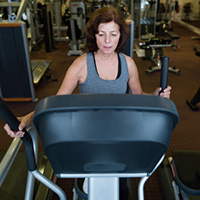
 A recent study found that aerobic exercise had a larger positive effect on the brain than stretching alone.1 The volume of the brain increased, according to MRIs. Also, the aerobic exercise group had a significant improvement on executive brain functioning tests. The researchers are hoping to find ways to head off or reduce the impact of Alzheimer’s Disease in seniors.
The study subjects all had mild cognitive impairment (MCI). MCI is a risk
factor for developing Alzheimer’s Disease. The 16 test subjects had an average age of 63. They participated in an aerobic exercise such as treadmill, elliptical, or stationary bike four times per week. The 19 members of the control group stretched instead.Research Study on Exercise
At the start of the study and after six months, all the study participants had MRI tests. The researchers were surprised to see a significant difference between brain volume growth in the two groups. Both had improvements, but the cardiovascular exercise group had greater preservation of total brain volume and an increase in local gray matter volume.
Additionally, the directional stretch of brain tissue was increased more for the aerobic exercise group. On the other hand, the group that only stretched their muscles had local atrophy within the white matter connecting fibers.
While the aerobic exercise group had improvements on executive brain functioning tests, the stretching group did not. Executive brain functioning refers to the mental skills which allow one to get things done – short term memory, taking initiative, keeping track of things mentally, planning, prioritizing, etc.
The researchers concluded that while any type of exercise is beneficial to the brain, cardiovascular exercise has a bigger impact on brain health.
Aerobic exercise and vision health: Did you know . . .
- Exercise reduces oxidative stress, which is an important factor in developing eye disease.
- Older mice had less oxidative stress in their retinas if they exercised.
- People who had high physical activity had less cataracts; couch potatoes had an above-average risk.2
- Regular exercise appeared to reduce the progression of glaucoma.3
- Past vigorous exercise was associated with a reduced risk of developing macular degeneration.4
- Exercise helps stave off Type II Diabetes and, therefore, diabetic retinopathy, a serious eye condition.5
Eye safety tips: Protect your eyes from chlorinated pool water by wearing swim goggles. If you have glaucoma, avoid head-down yoga positions and certain types of weight lifting. Wear sunglasses when you are outside in sunny conditions.
 Up Next: What’s Your Daily Dose of Exercise?
- Radiological Society of America Press Release, November 30, 2016. “Aerobic Exercise Preserves Brain Volume and Improves Cognitive Function.” Suzanne Craft, Ph.D., Youngkyoo Jung, Ph.D., and Christopher T. Whitlow, M.D., Ph.D. ↩
- Ophthalmology. 2015 Feb;122(2):274-80. doi: 10.1016/j.ophtha.2014.08.023. Epub 2014 Sep 27. Long-term physical activity and risk of age-related cataract: a population-based prospective study of male and female cohorts. Zheng Selin J et. al. ↩
- BMC Ophthalmology. 2016 Aug 23;16(1):147. doi: 10.1186/s12886-016-0326-x. The relationship between self-reported habitual exercise and visual field defect progression: a retrospective cohort study. By Yokota S. et. al. ↩
- British Journal of Ophthalmology. 2016 Oct;100(10):1353-8. doi: 10.1136/bjophthalmol-2015-307663. Epub 2016 Jan 19. “Past physical activity and age-related macular degeneration: the Melbourne Collaborative Cohort Study.” by McGuinness MB et.al. ↩
- “Association of Accelerometer-Assessed Sedentary Behavior With Diabetic Retinopathy in the United States.” Paul D. Loprinzi et. al. Journal of the American Medical Association Ophthalmology. 2016;134(10):1197-1198. doi:10.1001/jamaophthalmol.2016.2400 ↩
