
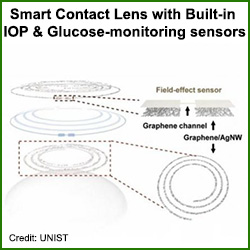
 Diabetics and glaucoma patients could start wearing comfortable smart contact lenses to monitor blood sugar and intraocular pressure. Professor Jang-Ung Park and colleagues in South Korea1 have solved some of the problems associated with smart contact lenses by using graphene. They recently released a study documenting their breakthrough research. These biosensors may have broad applications for detecting and treating disease.
Why Smart Contact Lenses?
Tears can indicate glucose levels in the body. Insulin-dependent diabetics need constant feedback to control their blood sugar. Finger pricks are problematic and annoying. Various devices have been invented that detect blood sugar levels. However, they are usually inserted under the skin. These methods are more invasive than a contact lens sitting on top of the eye.
Intraocular pressure (IOP) is a metric for many glaucoma patients. In glaucoma, the spongy trabecular meshwork that is the drain for the aqueous fluid gets clogged. Resulting increased IOP can result in optic nerve damage over time, leading to vision loss. Intraocular pressure is not perfectly correlated with the progression of glaucoma. However, eye doctors prefer frequent measurement of IOP. A common method for measuring IOP is an air puff machine that shoots a puff of air into each eye. Glaucoma patients must go to the doctor’s office, or invest in a home unit (which is expensive). The smart contact lens would provide more frequent data, under a variety of conditions.
Another study used a different smart contact lens and found that continuous monitoring is helpful. Glaucoma patients who had spikes in IOP while sleeping had more rapid progression of the disease.
The lens uses dielectric layers to detect IOP. The dielectric layers are electrically non-conductive. They have polarity that divides both positive and negative charges. The layers become thinner when IOP increases, and vice versa.
Smart Contact Lens Problems Solved
In the past, smart contact lenses have been more rigid. Some patients did not find them to be comfortable. The new smart contact lenses by Park etc. al. use electrodes made of very stretchy graphene sheets and metallic nanowires.
The electrodes are completely transparent. Some prior smart contact lenses had opaque parts, which partially obscured vision.
The sensors do not need a battery. The lens has a wireless antenna to read the sensor information. The antenna transmits the data to the doctor. The physician can monitoring health conditions real-time.
Editor’s Note: At Natural Eye Care, we offer information on both preventing disease and supporting eye health.
 Up Next: See our pages on Diabetes and Glaucoma.
- Ulsan National Institute of Science and Technology(UNIST). “‘Smart contact lens sensor’ for diabetic and glaucoma diagnosis.” ScienceDaily. ScienceDaily, 4 May 2017 ↩
