
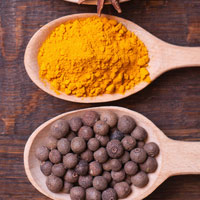
 Turmeric’s ability to support the body has been well-researched; however, this spice by itself is difficult for the body to absorb. This bright yellow spice is also called curcumin, and it contains a prized antioxidant. Research is verifying curcumin’s ability to reduce: inflammation, depression, pain and diabetes.
At Natural Eye Care, we often recommend curcumin or turmeric as a dietary supplement for patients who have, or are at high risk for an eye condition related to inflammation. For example, macular degeneration
and glaucoma appear to have an inflammation component. Curcumin supports glutathione synthesis, which is an important antioxidant for vision.
Take Turmeric with Black Pepper
Indian curry includes turmeric and black pepper. Modern research has shown that these two tasty spices, taken together, increased turmeric absorption2. Even a small amount of black pepper helps. If you do not eat large amounts of authentic Indian curries, you can add these spices to your cooking. Alternatively, capsules with curcumin and black pepper are available (BioPerine® is a patented thermogenic activator derived from black pepper, so the label might say “Curcumin with Bioperine®”).
Heat It
Turmeric is more easily absorbed if it is heated. This is not practical with capsules, but it’s a natural for cooking. Add a good amount to sautés and other suitable dishes. Sprinkle it on grains while they are cooking. And finally:
Take it with an Oil or Fat
Turmeric is fat-soluble, so take it with a healthy fat like olive oil, coconut oil or ghee (clarified butter). The oil makes the curcumin bypass the liver and go into the bloodstream through the lymphatic system.
These three tips sound like the basis of a delicious Indian meal! Indian cooking has all these elements. The spices are often heated in oil. Science now backs up the health effects of this cooking tradition.
You can also get curcumin, boosted with black pepper, in our online store.
Important Note: Before taking turmeric supplements check with your doctor if you are taking a blood thinner. While adding a bit of turmeric to your cooking is usually ok, more concentrated forms have a lot of punch. Curcumin, the active ingredient of turmeric is a blood thinner.
- “Curcumin uptake and metabolism” by Manfred Metzler et. al. 20 SEP 2012. BioFactors Special Issue: CURCUMIN. Volume 39, Issue 1, pages 14–20, January/February 2013 DOI: 10.1002/biof.1042 ↩
- “Why Pepper Boosts Turmeric Blood Levels” by Michael Greger M.D. on February 5th, 2015. https://nutritionfacts.org/2015/02/05/why-pepper-boosts-turmeric-blood-levels/ ↩
